
the wombs of pregnant stars
Jess Speedie, U. Victoria
summary
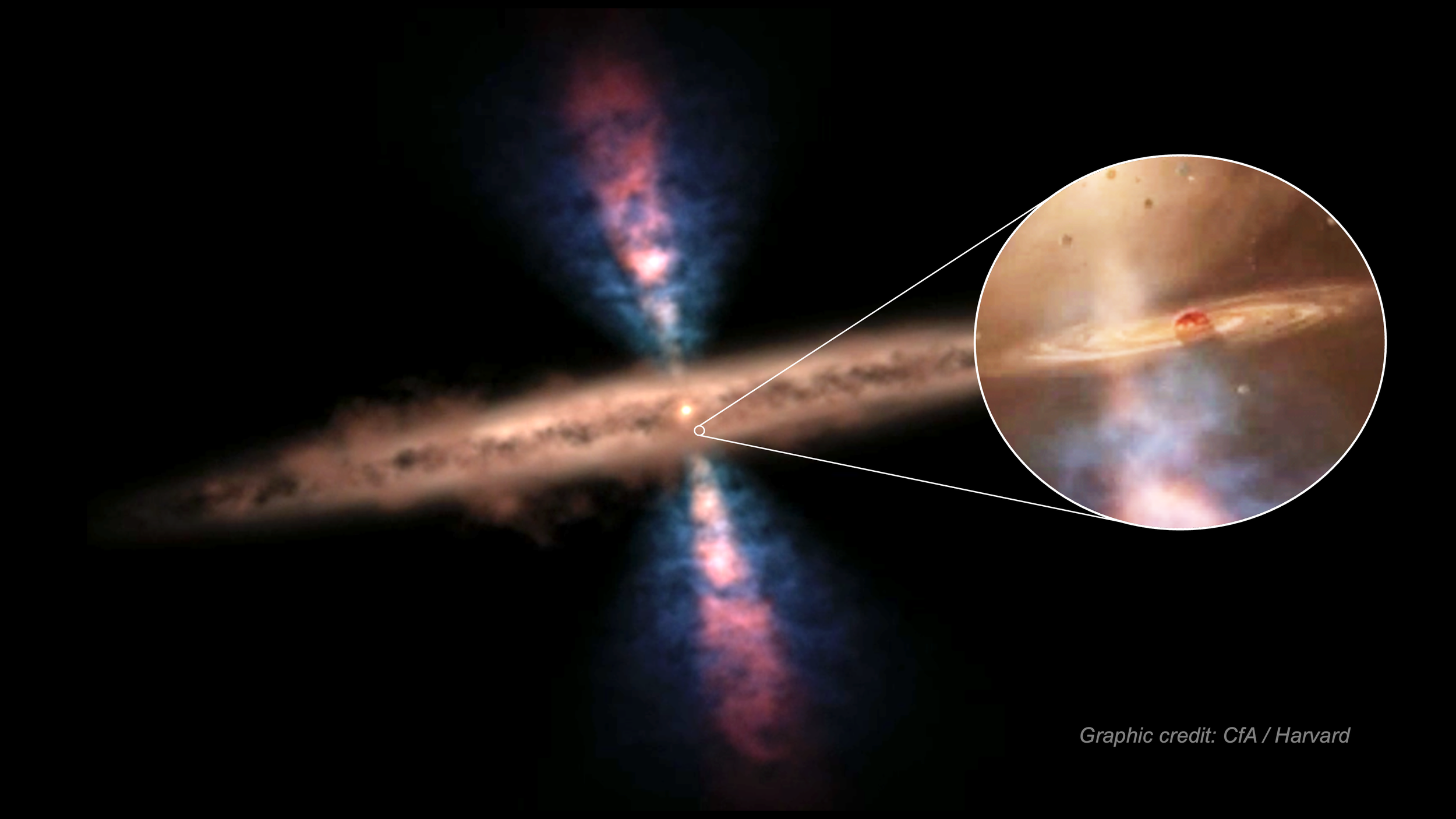
The womb of a pregnant star is a vast rotating disk of cosmic gas and dust, held together by the gravity of the host star suspended at the very centre. Somewhere in the disk, which can be a million times larger than the star itself, sibling planets are born.
At this Star Party, we’ll explore our modern understanding of “protoplanetary disks”, or stellar wombs: what they look like, what they’re made of, and how we can find the baby planets forming within them. We’ll delve into how today’s world-class radio telescopes can be used like astronomical ultrasound machines, creating detailed mappings of the spatial and kinematic structure of these cosmic nurseries. We’ll also showcase our current gallery of “baby photos” of planets, offering a glimpse into the universe’s youngest new worlds.
about the speaker

Jess Speedie
Jess Speedie is a Canadian astronomer and science communicator known for her research on planet formation and protoplanetary disks. Her observations and simulations shed light on the conditions that lead to the birth of new planets and how they can be detected deep within their natal environments. She is currently a PhD candidate at the University of Victoria and an ALMA Ambassador for the National Radio Astronomy Observatory. Jess received her BSc from McMaster University in Integrated Science and Physics in 2020. During her undergraduate studies, she held research assistantships at the Canadian Institute for Theoretical Astrophysics in Toronto and the Institute for Research on Exoplanets in Montréal.