
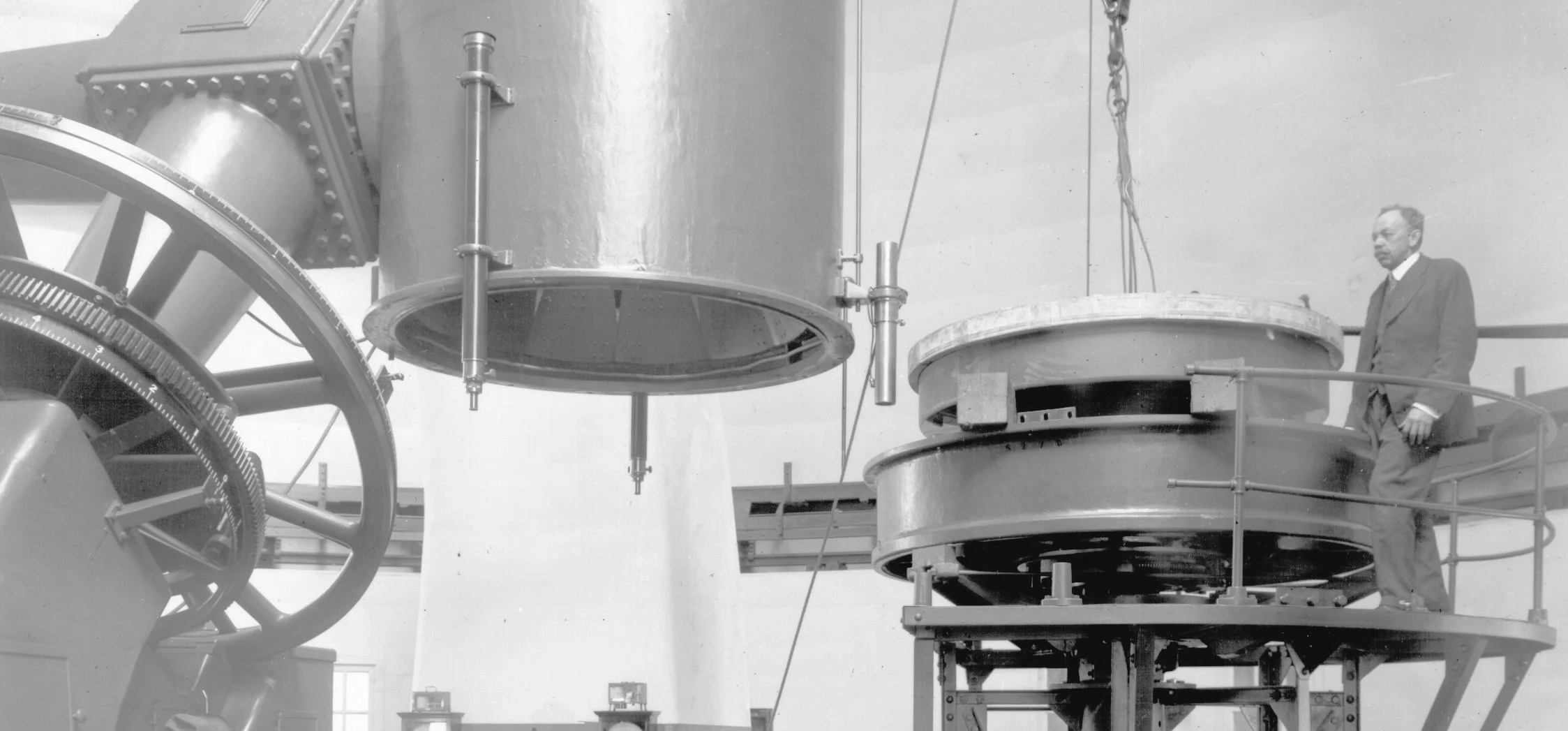
JOHN STANLEY PLASKETT
John Stanley Plaskett (JSP) conceived and designed the 1.8m telescope that now bears his name. His telescope design was copied for other telescopes around the world. He was an internationally recognized scientist and a strong proponent of public science outreach. JSP was born on a farm in southwestern Ontario in 1865. He was an inquisitive child performing various science experiments and was also mechanically gifted. He had to leave high school to run the family farm when his father died. Later, one of his brothers took over running the farm and JSP embarked on his career. He first worked for a firm in Woodstock, Ontario before working for the Thomas E. Edison company.
University & Early Career
During the 1890s, Plaskett worked as a mechanician in the physics department at the University of Toronto. Encouraged by his wife, he completed an honours degree in Physics and Mathematics in 1899. He continued to work at the University until 1903 when he was hired by Chief Astronomer William King to work in Ottawa's Dominion Observatory.
In one of his roles at the new observatory, Plaskett worked on the fledging Canadian Astrophysics programme. He applied his mechanical skills to improve the performance of the telescope and the spectrograph. Plaskett attended international scientific meetings and was a member of some very important working groups on aspects of astronomy. He realized that Canada’s contribution to the new field of astrophysics was very limited by the size of the telescope in Ottawa. In a critical 1910 meeting in Pasadena, he was convinced that Canada needed a much larger telescope if it was to contribute to a large international project to measure radial velocities of stars. He pursued this vision, with the support of his supervisor, William F. King, and finally managed to convince the Government to fund the project that would put Canada on the international scientific stage.
"The project for a great reflecting telescope of 72 inches aperture for the Dominion... has now crystallized into definite action as the contracts for the construction of the instrument have been awarded"


Plaskett's Star
As soon as the telescope became operational, Plaskett and his team began obtaining radial velocities for stars compiled from the Preliminary General Catalogue of Boss. Each star was observed several times to look for indiciations that the radial velocity varied - the tell-tale sign that the star was a spectroscopic binary star. Unlike the 60-inch telescope at Mt. Wilson, 100% of the Victoria telescope’s observing time was dedicated to the radial velocity program. The Victoria telescope quickly and in 1920 published a list of 100 spectroscopic binary stars. These were identified from a total of 574 stars that had radial velocity measurements.
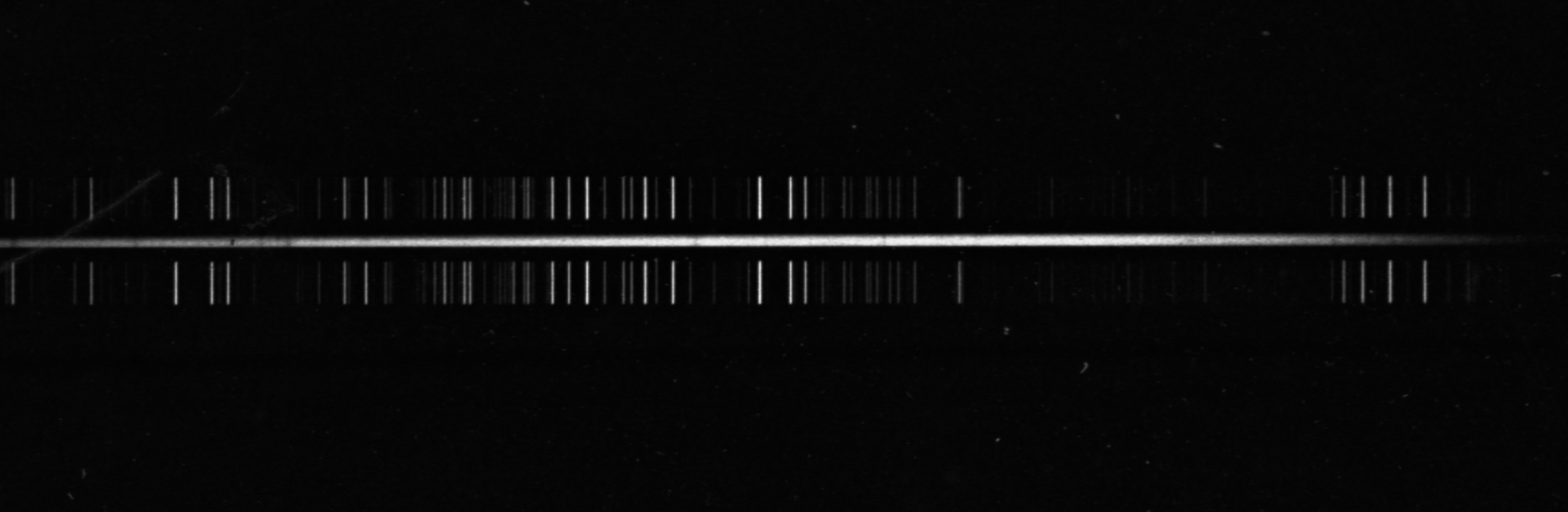
In December 1921, Plaskett obtained several measurements of one of the stars on his list. He quickly noted the stars velocity varied indicating a binary star system. Taking over 40 spectra, Plaskett estimated that the pair were 140 times the mass of the sun or more, 27,000 times brighter, and orbited each other in 14.5 days, making it the most massive pair of stars known to man. The image below shows the very first spectrum that Plaskett took of what became Plaskett’s Star. The bright vertical lines on either side of the spectrum of the star are emission lines of iron. These are used to calibrate the spectrum. You can see faint absorption lines in the spectrum of the star that are due to the various chemical elements in the star’s atmosphere. These lines shift position as the velocity of the star changes.
The discovery was covered in several prominent newspapers, reinforcing the promise of the new Victoria telescope while capturing the imaginations of people around the world.


Achieving the vision
Just 12 years after the observatory opened, it was the world leader in binary star observations. In January 1930, Plaskett reported that "of the 900 known binaries, 400 were discovered here; of more than 300 spectroscopic binaries with orbits measured by all the observatories in the world, 106 were measured by the observatory on Little Saanich Mountain.". The telescope Plaskett designed and built fulfilled his vision of Canada participating as an equal in a great scientific endeavour.
The Structure of the Milky Way Galaxy
One of the big scientific questions in the 1920s was the structure of the Milky Way. Driven by a desire to address this problem and understand the structure and shape of the Milky Way galaxy, J.S. Plaskett and J.A. Pearce laboured throughout the late 1920's on the study of the Milky Way. They amassed radial velocities for approximately 800 stars of O- and B-type. These stars are intrinsically very bright and hence can be seen at very large distances.
Along the way, they made a very important discovery. The space between stars is filled with diffuse gas and the Calcium in this gas absorbs some of the light of the distant star. Plaskett and Pearce determined that this gas rotates around the centre of the Milky Way in the same manner as the stars do. They also discovered that the strength of the absorption line of Calcium can be used to determine the distance to the star being observed. After compiling all of the data, and making thousands of laborious calculations (before computers!), they were able to determine the size of the Milky Way, its mass, its rotation period and the location of the Sun in the system. The picture they developed is essentially the same one we have today of the Milky Way Galaxy. Their image of the Milky Way is shown below.


