
Webb-inar: The JWST Star Party Part 2
December 18th 7:00pm - 9:30pm
Two options to participate
Featuring two talks!
- Supermassive Black Holes in the Infant Universe w/ Dr. Madeline Marshall
- An Ultra Faint Survey for Kuiper Belt Objects with the JWST w/ Dr. Wesley Fraser



Supermassive Black Holes in the Infant Universe
Abstract
Supermassive black holes lie at the centre of almost every galaxy in the Universe. Some of these black holes grow by feasting on nearby gas and dust, causing intense radiation. These growing black holes or ‘quasars’ are the brightest objects in the Universe, outshining all of the stars in their galaxy. Quasars have been discovered at extreme distances, when the Universe was less than a billion years old. This raises many questions about the growth of the first supermassive black holes and their host galaxies. I will discuss quasars and their mysteries, and how the James Webb Space Telescope will help to answer them.

Bio
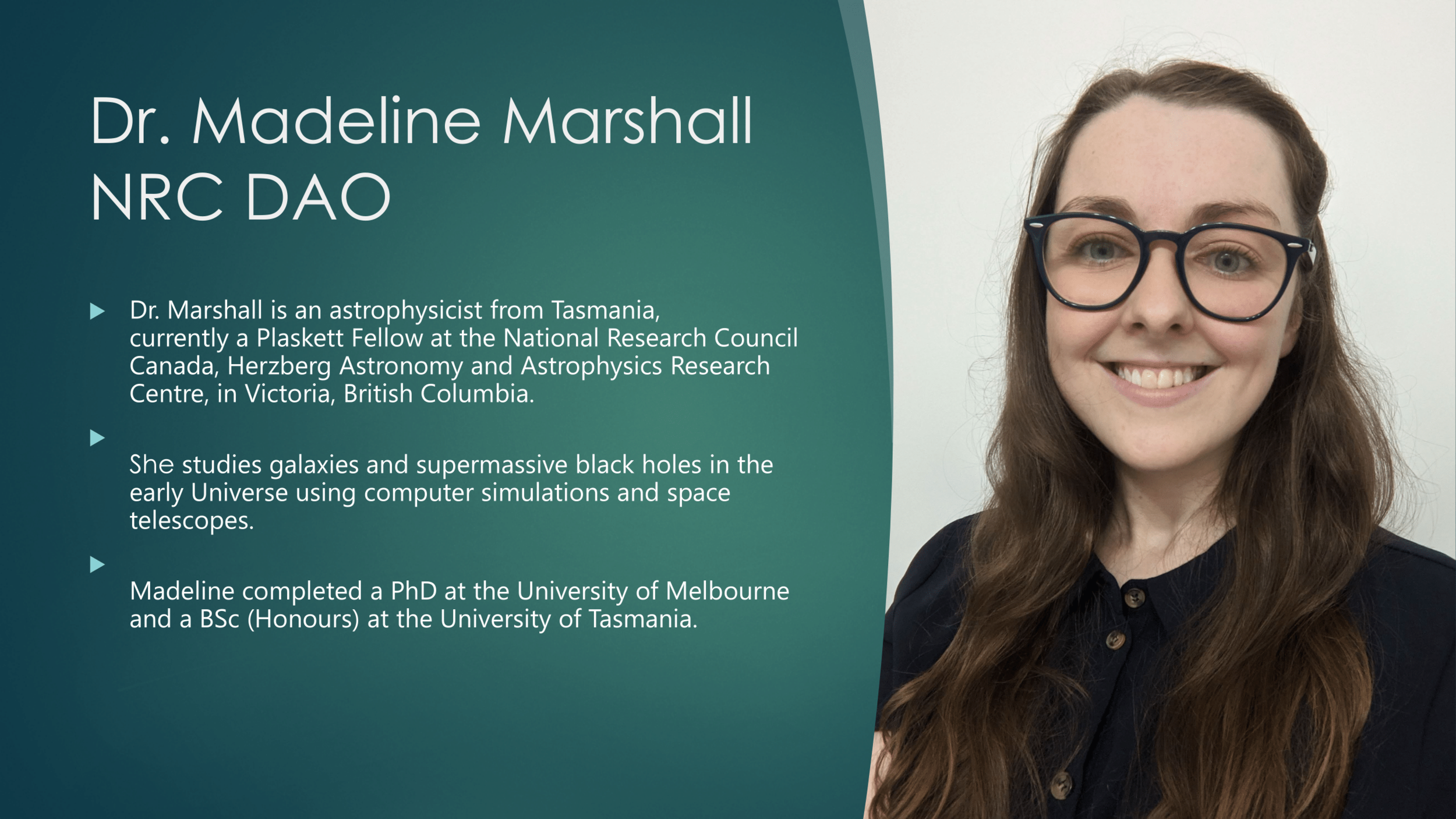
Dr Madeline Marshall is a Tasmanian astrophysicist currently working as a Plaskett Fellow at the DAO. She studies supermassive black holes in the early Universe using both simulations and space telescopes. Madeline is leading a JWST Cycle 1 program and is also involved in two JWST Guaranteed Time programs, which will study these quasars and attempt to answer some of these mysteries.
An Ultra Faint Survey for Kuiper Belt Objects with the JWST
Abstract
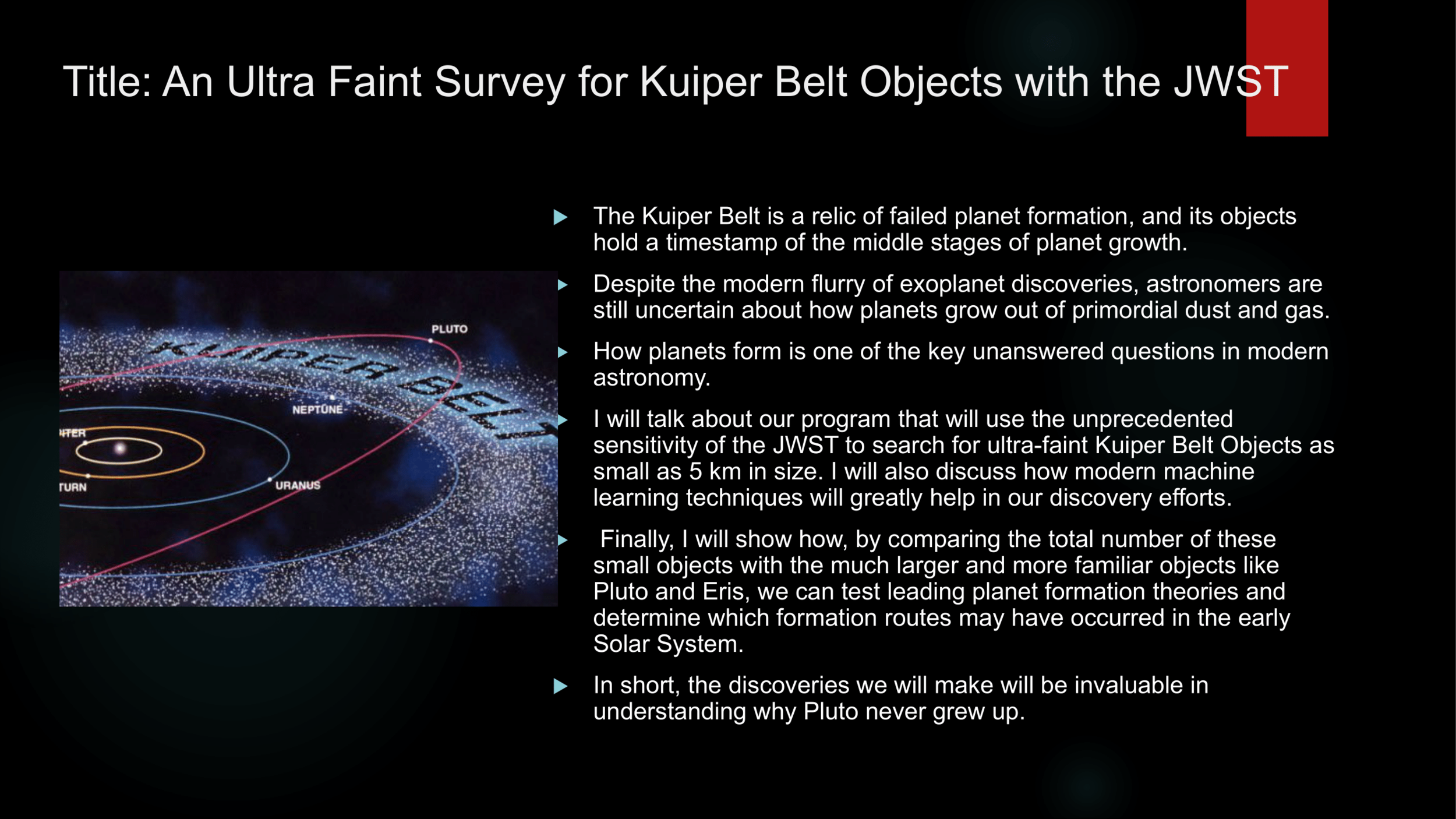
The Kuiper Belt is a relic of failed planet formation, and its objects hold a timestamp of the middle stages of planet growth. Despite the modern flurry of exoplanet discoveries, astronomers are still uncertain about how planets grow out of primordial dust and gas. How planets form is one of the key unanswered questions in modern astronomy. I will talk about our program that will use the unprecedented sensitivity of the JWST to search for ultra-faint Kuiper Belt Objects as small as 5 km in size. I will also discuss how modern machine learning techniques will greatly help in our discovery efforts. Finally, I will show how, by comparing the total number of these small objects with the much larger and more familiar objects like Pluto and Eris, we can test leading planet formation theories and determine which formation routes may have occurred in the early Solar System. In short, the discoveries we will make will be invaluable in understanding why Pluto never grew up.
Bio
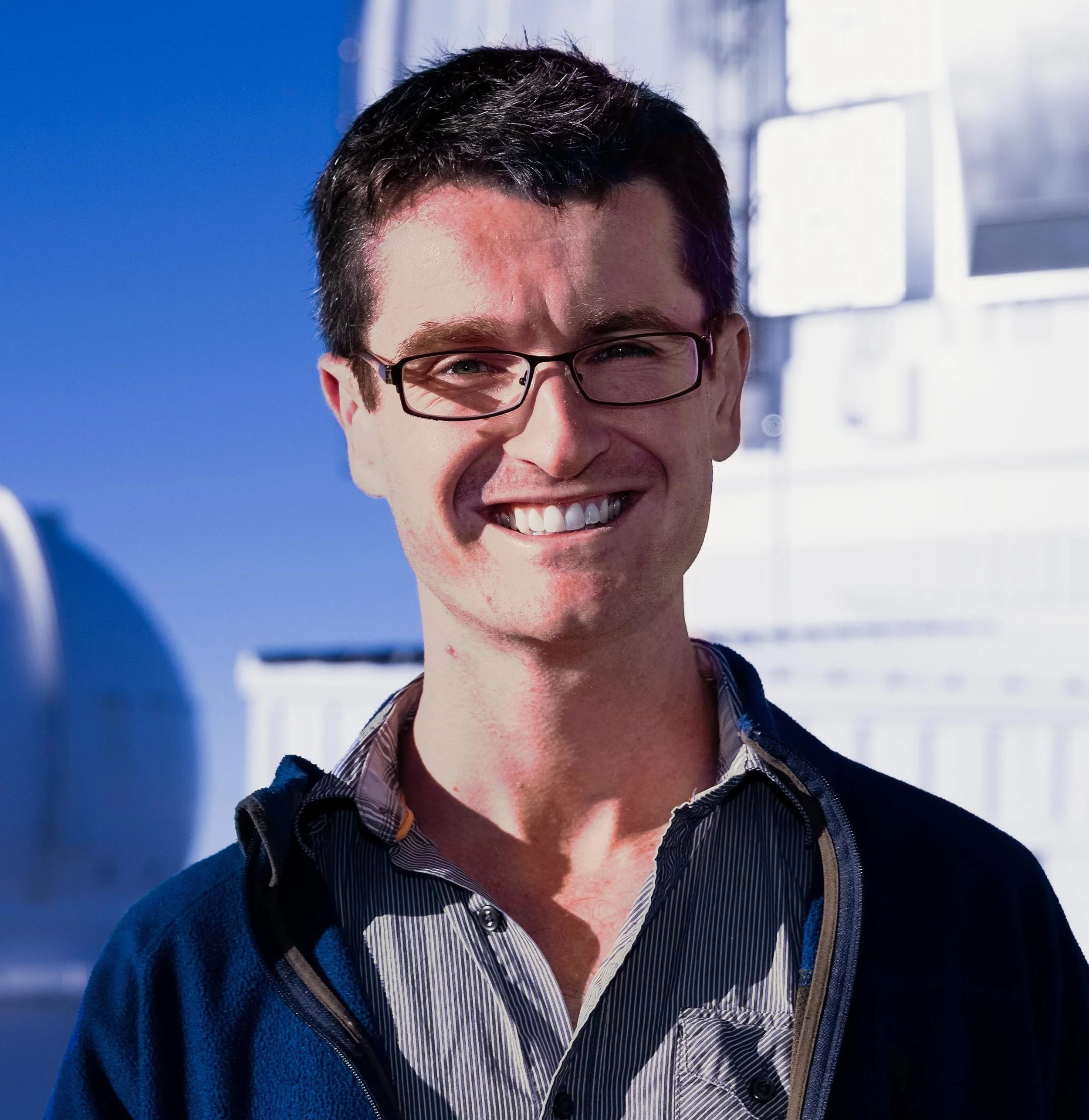
Wesley Fraser is a planetary astronomer with focus on trying to understand the planet formation process. Since being awarded his PhD in 2008 at the University of Victoria, he has spent much of his career performing telescopic observations of Kuiper Belt Objects and other faint moving bodies of the Solar System, such as the asteroids, and interstellar comets. Wes specializes in measuring surface compositions through spectroscopic observations, or to perform ultra-faint surveys to detect new objects.