

LESSON 3
How to find a planet
How do we begin?
When you look up at the night sky and observe the vast amount of stars in our Milky Way galaxy, how do we know which stars have planets?
Consider this photo, taken near Victoria, British columbia. Each spec of light you see is a star. The light creamy brown colors are also all stars that are so close together, you can't tell them apart! How on earth are we ever going to begin looking for planets through all of them?
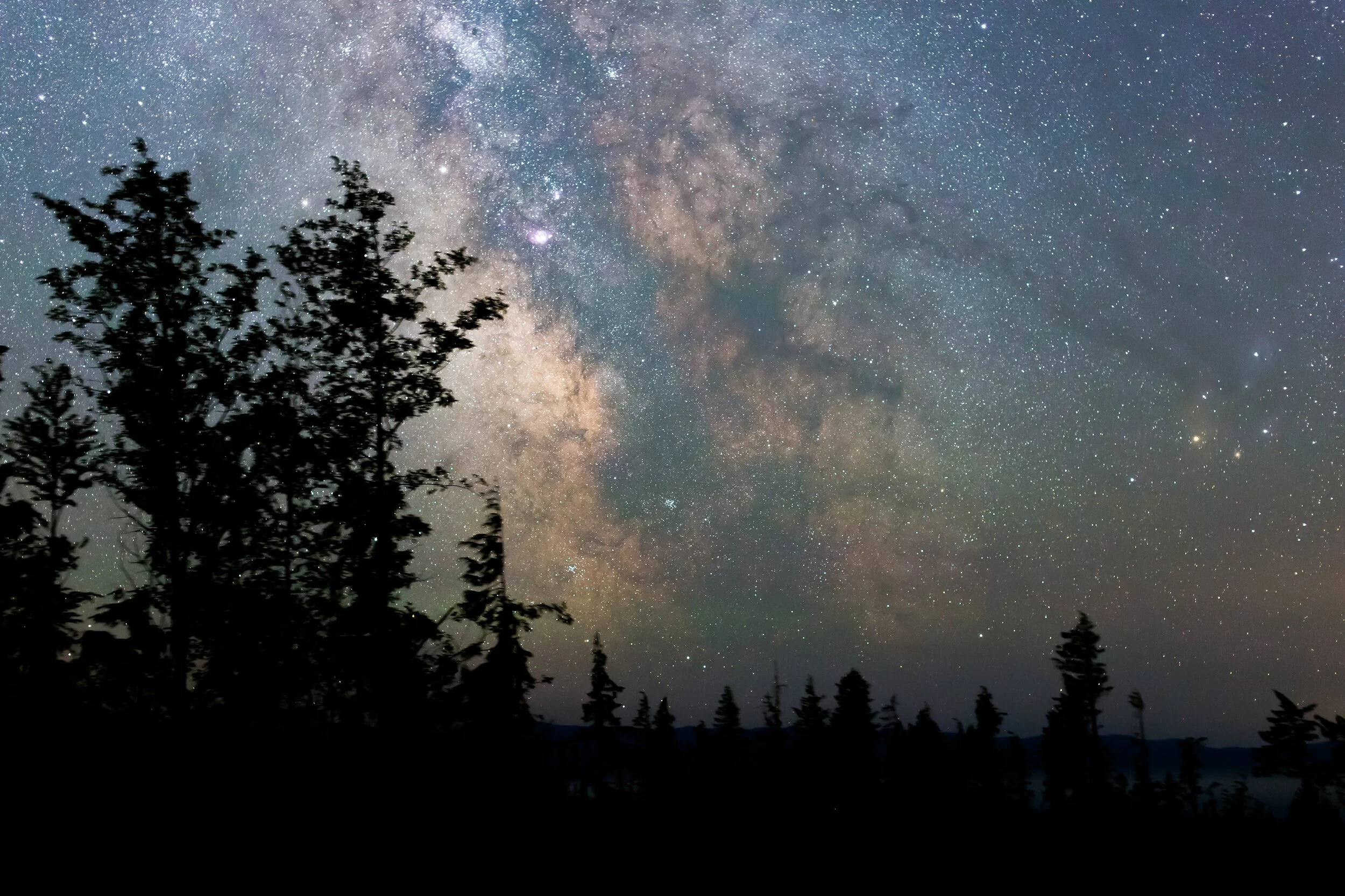
Could we look really closely at them and try and find a little speck of light that a planet might reflect from its host star (the "sun" for aliens on that planet)?
Maybe. But that has lots of issues. Stars are really far away - our telescopes are barely capable of seeing these planets around their stars. There are many reasons why this is so difficult, but the main one is that the stars are far away and the planets are faintly lit compared to the star they orbit.
If you don't believe me, which is brighter to us? A full moon? Or the Sun? A full moon is just the entirety of the moon reflecting sunlight back on us. So it has to be fainter than the sun itself. Similarly, the planets in the solar system all reflect light back into the universe, and so they must be fainter than the sun itself. Exoplanets - planets discovered outside of our solar system - are no different. They are much fainter than the star they're orbiting.
So how do we find exoplanets if they're so hard to find?
Well, we can't find all of them, but one of the most direct ways of finding an exoplanet (other than just trying to find its reflected light) is by staring at a star for a really long time and looking for a slight blink. When the planet momentarily blocks out the light (and we are paying super close attention), we can record a momentary blip in the light. This process is called photometry (the measurement of light), and is the basis for most observational astronomy.
Just like our own solar system, planets come in all kinds of shapes and sizes, and so they all produce different looking transits to our telescopes. Additionally, the orientation of the planet's orbit relative to our telescopes on Earth also plays a big role in how we observe the transit.
Now that you know more about Python, and that astronomers use Python to help them find exoplanets, we are going to run some transit simulations (an imitation of an exoplanet transiting a star), but you will get to build your own exoplanet and see what its light curve - or transit - might look to us!