
INTERNATIONAL ASTRONOMY DAY CELEBRATION
FEATURE PRESENTATION
The Pale Blue Data Point:
An Earth-Based Perspective on the Search for Alien Life
Dr Jon Willis, University of Victoria
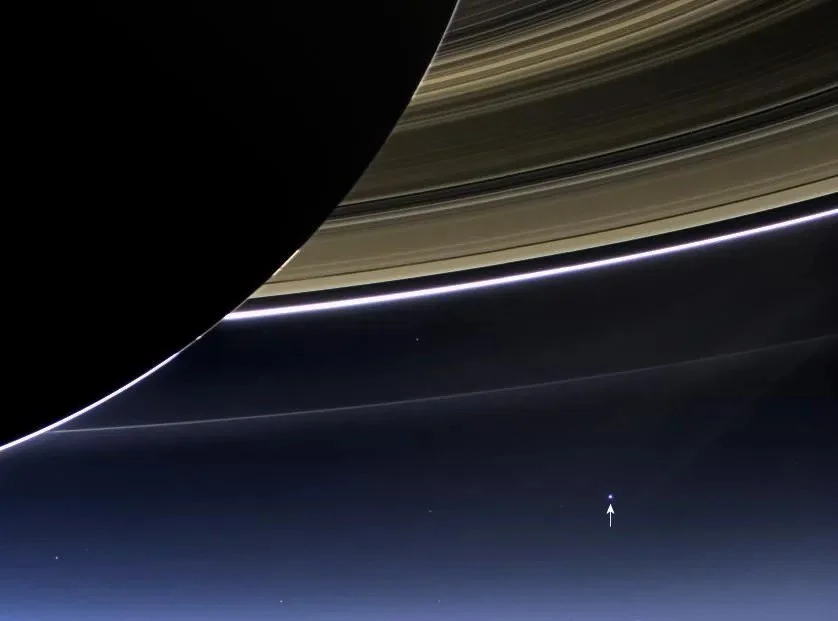
The Cassini spacecraft around Saturn reprises the Pale Blue Dot picture originally taken from Voyager I on Carl Sagan’s suggestion in July 2013 (Sagan passed away in 1996). Picture: NASA/ESA
Is there life off Earth? Bound by the limitations of spaceflight, a growing number of astrobiologists investigate the question by studying life on our planet. Astronomer and author Jon Willis shows us how it’s done, allowing readers to envision extraterrestrial landscapes by exploring their closest Earth analogs. With Willis, we dive into the Pacific Ocean from the submersible-equipped E/V Nautilus to ponder the uncharted seas of Saturn’s and Jupiter’s moons; search the Australian desert for some of Earth’s oldest fossils and consider the prospects for a Martian fossil hunt; visit mountaintop observatories in Chile to search for the telltale twinkle of extrasolar planets; and eavesdrop on dolphins in the Bahamas to imagine alien minds.
With investigations ranging from meteorite hunting to exoplanet detection, Willis conjures up alien worlds and unthought-of biological possibilities, speculating what life might look like on other planets by extrapolating from what we can see on Earth, our single “pale blue dot”—as Carl Sagan famously called it—or, in Willis’s reframing, scientists’ “pale blue data point.

Jon Willis is a professor of astronomy at the University of Victoria and author of The Pale Blue Data Point: An Earth-Based Perspective on the Search for Alien Life and All These Worlds Are Yours: The Scientific Search for Alien Life.
Jon will be signing copies of the book during the evening
Please note that tickets will be released on TUESDAY APRIL 14th at 5:00pm, and will be found below.